Q-Park announces Student Award winners 2026
Q-Park and Erasmus University Rotterdam held the 12th annual Student Award and Thought Leader Event at the De Hallen Studios in Amsterdam. The theme for this year’s event was The right to access: mobility in the growing city.
Q-Park organises this annual event to inspire and engage a diverse audience including public and private landlords, local officials, mobility providers offering car and bicycle rental and car sharing services as well as public transport operators.
Morning programme
The Waterkant café, located beneath the iconic circular car park ramps, was a cozy location to start the day. About 60 guests, including representatives from Amsterdam city council joined to hear more about the Q-Park Europarking site and future plans for the area.
Built in the 1970s, Q-Park Europarking is one of the few free-standing structures in Amsterdam and was designated a listed building (municipal monument) in 2018. This Brutalist-style structure is located on the inner ring road which follows the line of the city’s former defences. The centre of Amsterdam and all its attractions are within walking distance. More importantly, the parking facility serves the neighbourhood with many hub functions, including trams, buses and car rental. Q-Park and the municipality are working closely together to add amenities, enhance the public space and boost social safety, thus improving the quality for residents and visitors alike.
Student Award and Thought Leader Event
The afternoon programme took place in the De Hallen Studios, located in the former tram depot in the heart of Amsterdam-West. The industrial heritage site was repurposed in 2014 to become a vibrant hub for fashion, art, culture and crafts, including facilities for events.
Grand Cru 2026
Frank De Moor, Q-Park CEO welcomed over a hundred guests to one of the key 'knowledge sharing' events of the year and connecting with external stakeholders. He thanked all the students and their supervisors who submitted projects. “Since 2014, we've never had such a rich selection of theses to choose from. The quantity and quality of the research is excellent, we could have chosen six winners,” Frank De Moor said with a broad smile.
Keynote speakers on The right to access
Theo Thuis, President of the European Parking Association (EPA) and Managing Director of Innovation at Q-Park, introduced the keynote speakers.
Willem van Heijningen, traffic and public space strategist at the City of Amsterdam and project lead for Hubs Amsterdam. He acknowledged Amsterdam’s reputation for difficult and expensive parking, which is simply the result of a densely populated city that was originally designed for horse and cart and transport by water.
New developments present new mobility challenges as public space in Amsterdam is under immense pressure. From housing and EV charging points to greening initiatives and circular economy facilities. Everything requires space, yet such space in Amsterdam is in extremely short supply.
He emphasised that ‘the right to access’ includes the aging population, many of whom have to cope with reduced mobility. Currently Amsterdam has allocated 30,000 parking spaces for blue-badge holders, and this may need to double if nothing changes.
In Amsterdam, mobility measures are checked for their sustainability, social inclusivity and feasibility, and naturally, parking is part of that equation. “In this space strategy,” Heijningen explains, “we want to look less at the means of transport, and more at the purpose of the visit and determine access based on that.” This means that some groups, such as teachers, carers and nurses will keep their right to access, while others will be allocated parking spaces at hubs away from the city centre.
Amsterdam is also piloting a range of measures designed to reduce parking pressure in the inner city. This includes changing the accessibility focus from the vehicle to the person inside to ensure that the city remains accessible to all groups.
Carl Friedrich Eckhardt, group strategist at BMW, focused on how technological excellence, digitalisation, and responsible industrial practices can reinforce one another in an era of rapid transformation for the automotive sector. Eckhardt explained that BMW doesn’t only sell cars, “we’re part of a big ecosystem”. BMW focuses on those seeking new strategies to mobility issues where political problems often prevent progress and public funding also forms a bottleneck.
He observes that many cities, such as Paris and Amsterdam are on the right track: they are already implementing a mobility transition strategy. However, others, such as Rotterdam are challenging a fundamental assumption that no longer holds: mobility systems built on subsidised public transport and underpriced private car usage cannot simply be incrementally adapted to become ‘fit’ for future decades.
Eckhardt argues that political controversy blocks sound solutions to traffic problems and polarises the pro-car protectionists against the anti-car activists. Efforts should focus on bridging the gap: based on increasing road traffic efficiency, essential societal values, allowing advantages for all, and thus paving the way for broad political support.
He also advocates a standard price approach with measurable objectives and appropriate pricing, applicable to parking, traffic flow and air quality. In future, driverless fleets could meet the structural mobility needs as they can turn changes in mobility behaviour from a political risk into an opportunity. These potential advantages for all are promising, but require all players to adapt.
Q-Park Student Award 2026
After a short networking break, Giuliano Mingardo, senior researcher at Erasmus University Rotterdam, gave a brief history of the Q-Park Student Award.
Since 2014, Q-Park and Erasmus University Rotterdam have partnered to facilitate this annual event, the mission being to bridge the knowledge gap in parking and mobility between the academic world and the parking industry.
The award is open to all bachelor and master students in Europe and since its inception, some 120 theses have been submitted on a wide range of topics. A great deal of knowledge has been generated and shared, and above all, the quality increases every year.
This year, 19 projects were submitted from nine universities in Belgium and the Netherlands. Thanks to the work of these students, we now know more about:
Public transport and road closures
Rail maintenance and passenger behaviour
- Rail maintenance closures of up to a week have no lasting effect: passengers return to their usual patterns. Closures of eight days or more, however, permanently reduce the number of train trips.
- Splitting long maintenance works into shorter periods could therefore protect ridership.
Highway closures and rail ridership
- Highway closures also only matter beyond about eight days: then rail ridership rises by around 3.7% at a typical detour, and more when the detour is longer. Shorter closures have no measurable effect.
- Railway operators can now forecast this extra demand before a closure begins.
The E-line metro and car ownership
- Car ownership near the new E-line stations between Rotterdam and The Hague fell by roughly 2 to 3 cars per 100 households compared with areas further away, although this cannot be firmly attributed to the metro alone.
Car sharing, pricing and behaviour
Car sharing in Flemish municipalities
- How many private cars can be replaced by a single shared car is not a fixed number (estimates range from 3 to 9). The number depends on local context, especially household size, car ownership and the supply of shared cars.
Climate surcharges on air tickets
- Travellers accept a mandatory climate surcharge on flights much more readily when it is earmarked for sustainable aviation fuel than when it goes into a general fund, worth about €8.78 per ticket.
- Simply making the payment mandatory does not increase acceptance.
Accessibility and employer attractiveness
- Commuting time hardly affects how attractive employees find their employer. Mobility benefits, especially the lease bike, help a little, but good and supportive employership matters far more.
Cycling
Locations for cycle service points
- The best place for cycle service points (parking, repair, rest) is not near homes but on the routes cyclists actually ride. Just five well-placed points would serve 8.5% of all peak-hour commuter cyclists in the Eindhoven region.
Cycle highways and car traffic
- There is no evidence that cycle highways reduce car commuting on parallel roads in the first four years after opening. Road relief is neither proven nor ruled out, so investment appraisals should not simply assume it.
Electric vehicles and charging
Charging under grid-capacity limits
- Smart scheduling algorithms allow a parking facility with a fixed 50 kW grid connection to run significantly more chargers than today’s static power allocation, without a costly grid upgrade.
Phase balancing with coordinated charging
- Smart charging that optimises only on cost can make grid voltage imbalance 80% worse, because it makes all cars charge at the same time.
- Coordinated phase switching brings imbalance well within the norm at almost no extra cost, and this was validated on real charger hardware.
Vehicle-to-grid and battery degradation
- Using EV batteries for standard grid frequency regulation (V2G) causes negligible extra heat and battery wear. Simple, standard cooling is sufficient.
Parking and Park + Ride
Amsterdam’s 10-cent parking zones
- Abolishing Amsterdam’s subsidised 10-cent short-stay parking did not harm local shops. There was no measurable effect on retail vacancy, not even for the short-trip shops the policy was meant to protect.
Park + Ride in Flanders
- For P+R users, a guaranteed parking space matters most, more than cost or public transport frequency. Appearance of the facility matters least. Policymakers rarely mention this need for certainty.
Mobility transition in medium-sized towns
- Medium-sized Dutch towns combine car, active and shared mobility in redevelopment projects, parking cars in hubs to free up public space. Parking regulation and public resistance to it are their biggest challenges.
Mobility hubs in low-car neighbourhoods
- Real-time information, comfortable waiting areas and toilets make neighbourhood mobility hubs most attractive, while surveillance cameras add the least value.
To select the winners from this rich pool of knowledge, a panel of Parking & Mobility experts assessed the submissions and selected three finalists. Each of the winning students gave a brief presentation explaining their research and findings.
The winners are:
- Quinty Okhuijsen, TU Delft: One commute, multiple perspectives.What makes a mobility policy worth implementing?
- Sweder van der Kwaak, Erasmus University Rotterdam: Does shared mobility reduce private car ownership? Evidence from neighbourhood-level panel data in the Netherlands
- Chris Juárez Overdevest, TU Delft: The impact of car-reducing measures on travel behaviour across socio-demographic groups: an activity-based approach
A summary of these three theses and the winning theses from previous years are available on the Q-Park Student Award website.
Following the three winning student presentations, Frank De Moor presented each of the winners with a cheque for €1,500.
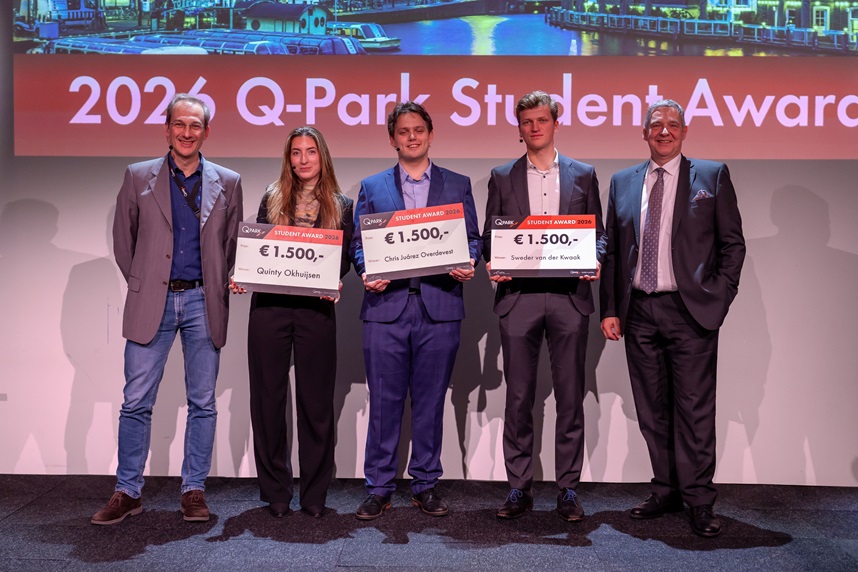
Q-Park looks back on a successful day of learning and networking.